

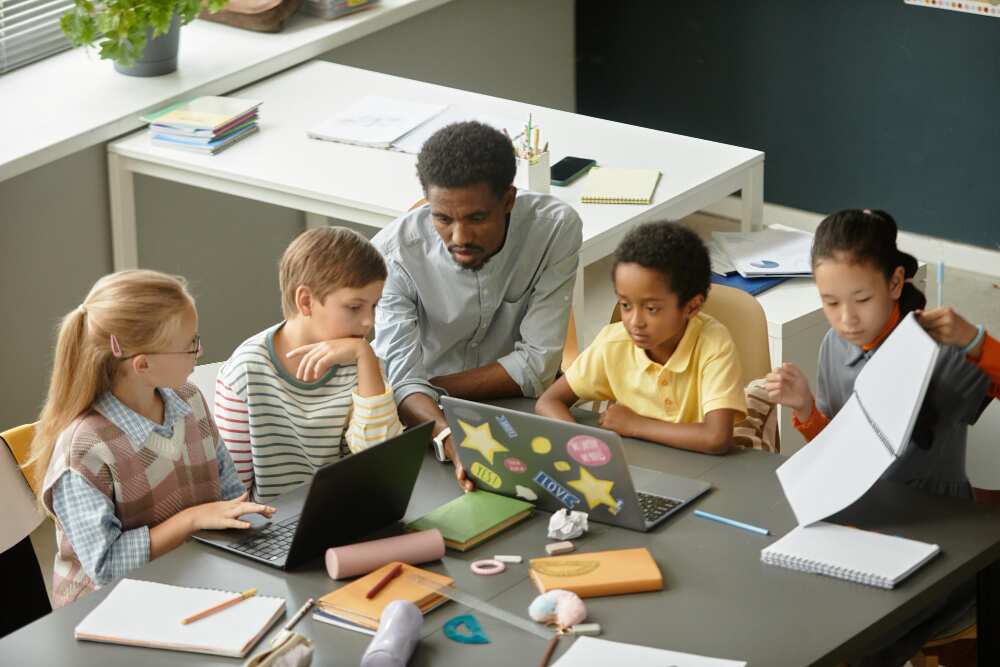
Traditional classrooms often placed the educator at the focal point, delivering direct lectures while students sat in isolated rows absorbing information passively. While direct instruction still holds value for baseline content delivery, modern educational psychology demonstrates that passive listening rarely produces deep conceptual mastery. Collaborative learning shifts the educational dynamic by placing students in structured, peer-led environments where they must actively construct meaning together.
Collaborative learning involves pairs or small cohorts working jointly to explore a topic, solve a challenging problem, complete an authentic task, or design a tangible deliverable. When executed with proper instructional scaffolding, this paradigm does more than reinforce subject-matter recall. It serves as a comprehensive training ground for foundational academic competence, sophisticated cognitive strategies, and lifelong social capabilities that students carry into modern professional environments.
The Cognitive Architecture Behind Peer-to-Peer Learning
To understand why collaborative learning builds robust student capabilities, one must examine how human memory and cognition operate during interactive discourse. Knowledge acquisition is not a simple recording process. It requires cognitive restructuring, schema modification, and active retrieval practice.
-
Cognitive Reorganization: When students articulate their thought processes out loud to explain a concept to a confused peer, they are forced to organize their internal thoughts clearly, identify logical fallacies in their own mental models, and simplify abstract concepts.
-
Immediate Feedback Loops: Peer discussions create continuous, real-time micro-feedback. If a student presents a flawed premise or miscalculates a step, group members can challenge that reasoning immediately, preventing the consolidation of misconceptions.
-
Elaborative Processing: Debating nuances with peers forces students to connect new data points to their prior knowledge bases, anchoring information deeply into long-term memory.
-
Zone of Proximal Development: Learners often grasp complex explanations more readily from peers who recently navigated the exact same intellectual hurdle, as peer explanations frequently use shared, accessible vocabulary rather than formal academic jargon.
Developing Advanced Problem-Solving and Critical Thinking
Rote memorization often creates brittle knowledge that crumbles when applied to non-standard questions. Collaborative inquiry cultivates flexible problem-solving frameworks by exposing students to multiple approaches for reaching a single resolution.
When a group encounters an open-ended engineering challenge, case study, or historical primary source, individual members naturally propose contrasting hypotheses. Navigating these divergent viewpoints requires students to weigh evidentiary support, test assumptions, and evaluate competing tradeoffs before reaching consensus.
Through this iterative discourse, students learn that academic problems rarely have a single obvious pathway. They develop intellectual humility and adaptability, recognizing that alternative perspectives can expose blind spots in their initial reasoning.
Cultivating Interpersonal Competence and Emotional Intelligence
Academic knowledge alone does not guarantee future success. Modern workplaces demand professionals who can navigate complex interpersonal dynamics, manage conflict constructively, and collaborate across diverse ideological frameworks. Collaborative classrooms act as low-stakes laboratories for cultivating these non-cognitive competencies.
Active Listening and Perspective Taking
In a collaborative exercise, students cannot simply wait for their turn to speak. They must listen attentively to comprehend their peers’ viewpoints and formulate meaningful contributions. This continuous practice strengthens empathy and teaches learners to respect perspectives shaped by different life experiences and cognitive styles.
Constructive Conflict Negotiation
Disagreement is an inevitable aspect of group problem-solving. Through guided peer activities, students discover how to challenge an idea without attacking the person delivering it. They learn how to:
-
Reframe confrontational language into exploratory questions.
-
Identify common baseline goals when opinions diverge.
-
Compromise on tactical details to ensure project milestones are met.
-
Distribute tasks equitably based on individual strengths.
Shared Accountability and Self-Regulation
When working independently, students often answer only to an instructor. In a well-structured collaborative setting, learners experience social interdependence. They understand that their preparation level directly impacts the success of their teammates. This dynamic fosters intrinsic motivation, personal accountability, and time-management discipline.
Enhancing Oral Communication and Articulation
A profound grasp of a concept means very little if an individual cannot communicate that understanding coherently to an audience. Collaborative assignments provide continuous, low-pressure opportunities for students to practice oral articulation.
Introverted students who find public speaking before an entire lecture hall intimidating frequently thrive when speaking in four-person groups. The small group dynamic reduces public speaking anxiety, allowing students to test out tentative ideas, ask exploratory questions, and refine their verbal delivery. Over time, this daily conversational practice translates into higher self-efficacy during formal presentations, seminars, and professional interviews.
Effective Frameworks for Implementing Collaborative Learning
Placing students in arbitrary groups and instructing them to work together rarely yields optimal pedagogical outcomes without structured design. To maximize skill acquisition and prevent free-riding, educators employ established collaborative frameworks:
-
Think-Pair-Share: Students first reflect and write independently on a prompt, discuss their findings with a partner to refine their arguments, and finally share their synthesized conclusions with the larger class.
-
Jigsaw Method: Each student within a home group becomes an expert on a specific subtopic by conferring with members of other groups assigned the same content. They subsequently return to their home group to teach their specialized knowledge to their peers.
-
Peer Instruction with Concept Tests: Instructors present conceptual multiple-choice questions. Students register individual votes, discuss their reasoning with neighbors for several minutes, and revote, consistently showing marked improvements in conceptual clarity.
-
Problem-Based Learning Cohorts: Teams are presented with complex, authentic, ill-structured dilemmas that require cross-disciplinary research, role delegation, and collaborative synthesis to produce viable solutions.
Long-Term Impact on Retention and Academic Persistence
Research across various grade levels and academic disciplines consistently demonstrates that active, peer-centered learning reduces failure rates and increases overall course completion metrics, particularly in demanding fields like science, technology, engineering, and mathematics.
By shifting the classroom climate from a competitive environment to a supportive community of practice, collaborative learning diminishes academic isolation. Students build informal study networks that extend beyond the classroom walls, providing ongoing academic and emotional support throughout their educational journeys.
Frequently Asked Questions
How does an instructor prevent higher-performing students from doing all the work in a group?
Educators prevent unequal workloads by implementing individual accountability mechanisms alongside group grading. This includes requiring individual component submissions, conducting randomized individual check-ins, utilizing peer evaluation rubrics, and assigning specific rotating operational roles within each team.
What is the ideal group size for effective collaborative learning exercises?
For most classroom and laboratory settings, groups of three to four students offer the ideal balance. This size is large enough to ensure diverse perspectives and dynamic discussions, yet small enough to prevent individual members from disengaging or hiding behind more vocal peers.
How does collaborative learning benefit students who are naturally introverted?
Small collaborative groups provide a low-stakes environment with less social exposure than a full classroom. Introverted learners can share ideas comfortably, receive immediate positive reinforcement from peers, and practice public communication without the pressure of speaking before a large audience.
Can collaborative learning methods be implemented effectively in asynchronous online courses?
Yes. In asynchronous environments, instructors use structured discussion boards, shared cloud documents, collaborative wikis, and peer review systems. Clear deadlines for initial posts, required peer responses, and milestone tracking ensure active participation across different time zones.
What should an educator do when a group experiences irreconcilable interpersonal conflict?
Rather than immediately disbanding the group, the instructor should use the conflict as a pedagogical teaching moment. Facilitating a guided mediation session allows students to articulate their expectations, review their team charter, redistribute roles, and practice professional resolution strategies.
How does collaborative learning differ from simple cooperative group work?
Cooperative learning often involves dividing a task into discrete pieces that students complete individually and stitch together at the end. In contrast, true collaborative learning requires mutual intellectual engagement, joint meaning-making, and collective problem-solving throughout the entire process.
Is collaborative learning suitable for teaching highly foundational or factual material?
Yes. Even with foundational facts, collaborative methods like peer quizzing, flashcard reviews, and reciprocal teaching help students consolidate rote material into memory much faster than isolated memorization strategies.