

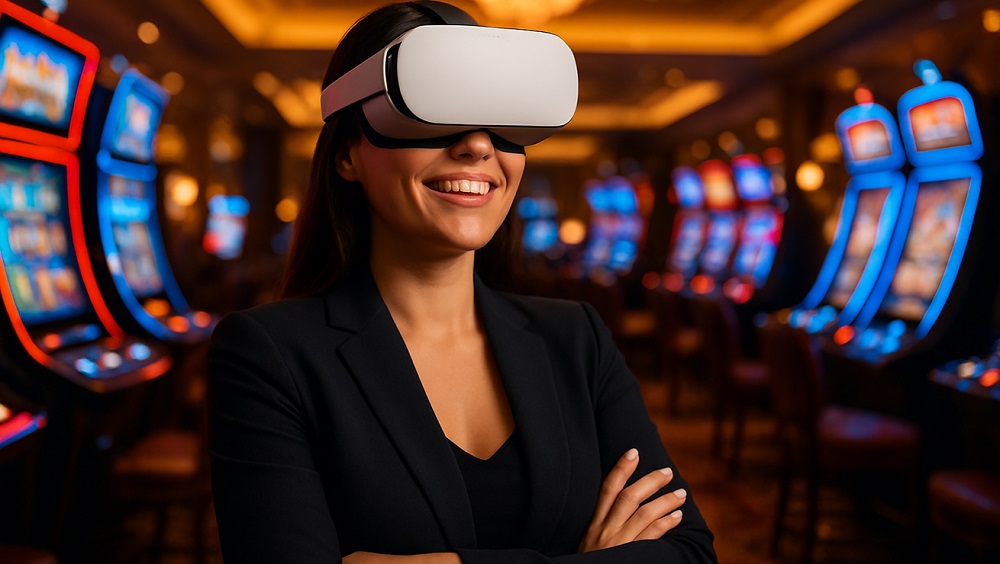
The casino sector has always adapted rapidly to technological change. From mechanical reels to video poker, and eventually to web browsers and smartphone applications, the pursuit of immersion remains constant. Today, the gambling world is undergoing another transformation driven by virtual reality hardware and spatial software. Online gaming is moving beyond flat, two-dimensional screens toward fully interactive three-dimensional spaces, redefining how players interact with games, environments, and each other.
The Evolution from Traditional Online Gambling to Spatial Gaming
Online gambling established a strong reputation for convenience. Players gained the ability to spin slot machines or bet on digital blackjack tables from home. However, flat interfaces came with a notable drawback: they stripped away the atmosphere, sensory stimuli, and social energy of brick-and-mortar casino resorts.
Live dealer games attempted to bridge that divide by streaming real humans running tables in physical studios. While effective, the user remained an outside observer looking through a flat screen. Virtual reality changes that perspective entirely.
By donning a consumer headset, players step onto a simulated casino floor. Instead of clicking buttons, users physically look around opulent ballrooms, stroll past digital slot machines, sit down at felt-topped gaming tables, and hear three-dimensional spatial audio that accurately reflects proximity and direction.
Technological Pillars Enabling the Shift
The current wave of virtual casino spaces depends on a collection of hardware and software innovations operating in sync:
-
High-Resolution Headsets: Modern standalone headsets provide high pixel densities and broad fields of view, eliminating the screen-door effect that hindered early consumer adoption.
-
Spatial Audio Engines: Positional sound gives audio physical depth. A player hears the whirr of a slot wheel over their left shoulder or background jazz melodies echoing across the casino lounge.
-
Natural Hand and Controller Tracking: Advanced infrared sensors and computer vision track individual finger movements, allowing users to physically pick up chips, squeeze cards, and pull slot levers.
-
Haptic Feedback: Precision haptic actuators built into modern controllers generate subtle vibrations that emulate the weight of rolling dice or the physical click of a roulette wheel.
-
Cloud Rendering and Fast Connectivity: High-speed internet and low-latency rendering pipelines ensure smooth 90-hertz and 120-hertz frame rates, preventing the motion discomfort previously associated with virtual navigation.
Core Benefits Reshaping the Player Journey
Virtual environments bring specific practical and experiential advantages to modern iGaming operations.
Authentic Social Engagement
Standard online casino platforms can feel solitary. In contrast, virtual reality introduces dynamic avatars that mimic user head tilts, hand gestures, and spoken conversations in real time.
-
Players converse with competitors at high-stakes poker tables, watching subtle head tilts and movements for behavioral tells.
-
Groups of friends can assemble at the same craps table, high-fiving across the green felt after a winning roll.
-
Dedicated social areas, such as rooftop lounges and interactive cocktail bars, allow visitors to relax away from betting tables.
Unlimited Spatial Architecture
Physical casino resorts face real-world architectural limits, zoning laws, and floor plan boundaries. Virtual environments operate under no such constraints.
A virtual casino can be modeled as a vintage Monte Carlo parlor, a high-rise Las Vegas penthouse overlooking neon skylines, or a futuristic establishment on a space station. Designers have complete freedom to scale rooms, create custom themed lobbies, and offer private VIP suites that would be structurally impossible or cost-prohibitive in the physical world.
Deep Interaction with Game Mechanics
Rather than tapping automated buttons, virtual interaction mirrors physical movement. Players stack their own wagering chips, inspect the texture of card decks, and physically toss dice across the table. This active physical participation increases player agency and heightens immersion.
Comparing Casino Formats
| Feature | Land-Based Resorts | Traditional Online Platforms | Virtual Reality Casinos |
| Accessibility | Requires physical travel | Instant across standard devices | Requires compatible headset hardware |
| Sensory Immersion | Complete real-world environment | Low, confined to 2D displays | High, 360-degree virtual simulation |
| Social Mechanics | In-person conversations | Text-based chat boxes | Voice proximity and avatar body language |
| Floor Boundaries | Constrained by building layout | Grid-based menu systems | Infinite thematic space |
| Physical Tactility | Genuine physical objects | Mouse clicks and touchscreen taps | Motion controllers and haptic feedback |
Overcoming Current Industry Roadblocks
Despite clear momentum, virtual reality gambling faces structural challenges before achieving universal mainstream adoption:
-
Hardware Costs: Although headset prices have dropped significantly, high-fidelity standalone systems still require a dedicated financial investment from casual users.
-
Regulatory Ambiguity: Gambling jurisdictions worldwide are still updating legal frameworks to monitor virtual reality operators, ensure cross-border tax compliance, and regulate proprietary digital assets.
-
Bandwidth Demands: Seamless visual fidelity without latency artifacts requires fast broadband connections, which limits accessibility in areas with underdeveloped digital infrastructure.
-
Responsible Gaming Oversight: Deep sensory immersion makes it easy for players to lose track of time. Regulators and platform operators must build native safety mechanisms, such as mandatory headset break prompts, spending caps, and real-world clock displays inside the headset view.
The Long-Term Trajectory of Virtual Casinos
As mixed reality and lightweight spatial computing glasses mature, the line between virtual casinos and physical reality will continue to soften. The integration of blockchain ledger technology allows for provably fair algorithmic audits and authentic ownership of virtual collector items. At the same time, hybrid mixed-reality modes enable players to project interactive poker tables directly onto their physical living room coffee tables while still viewing their actual physical surroundings.
The shift toward virtual reality in modern casino design is not merely a visual upgrade. It represents an overhaul of digital entertainment, transforming solitary screen-tapping into a shared, physical, and sensory experience.
Frequently Asked Questions
What minimum internet speed is recommended for smooth virtual reality casino gameplay?
A stable internet connection with download speeds of at least 50 megabits per second and low latency (under 30 milliseconds) is generally recommended to prevent frame drops, lag, and visual desynchronization during live multiplayer sessions.
Can players use standard motion controllers or do they need specialized haptic gloves?
Standard tracked controllers that ship with major consumer headsets are the primary input method. Specialized data gloves and fine-haptic accessories remain optional hardware upgrades supported only by select niche applications.
How do virtual reality casinos prevent underage access and verify player identity?
Operators use multi-step Know Your Customer protocols during account registration. This includes digital identity verification, facial recognition scans, and payment verification checks before granting access to real-money environments.
Are virtual reality casino games provably fair compared to traditional slot machines?
Yes. Licensed virtual reality games use certified Random Number Generators that undergo identical auditing and compliance testing required of standard regulated online casinos. The virtual representation is simply a visual layer applied to verified game algorithms.
Do virtual reality casinos support both real-money wagering and free-play social modes?
Yes. Many platforms provide free-to-play social modes using virtual tokens, allowing users to play games and socialize without financial stakes, alongside licensed real-money lobbies available where legally permitted.
How do operators address motion sickness and physical fatigue during long sessions?
Developers use tele-portation movement systems, fixed focal horizons, high refresh rates, and static seating configurations to eliminate visual-vestibular conflict. Built-in session timers also notify users to take periodic physical breaks.